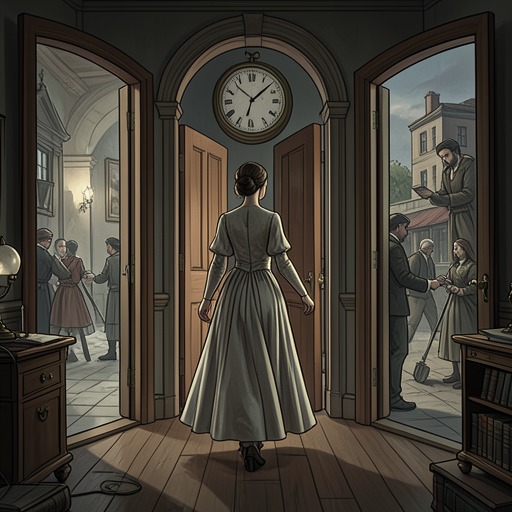
Poppy continues Marco’s life and glassmaking skills
The Reincarnationist PapersPoppy’s connection to Marco Parcalus is a relationship across incarnations: she remembers having lived as Marco, a master glassmaker on Murano, and carries the knowledge of that life into later ones. Their continuity is not merely a shared interest or a story Poppy has inherited. She tells Evan Michaels that the scenes in the tomb’s stained glass depict people from her own lives, and identifies Marco’s escape from Murano as one of those experiences. The episode links an intensely specific craft, a perilous break from a closed community, and Poppy’s present-day practice into one remembered life.
Identity and Continuity
Poppy places Marco fourth in the sequence of her lives. Before that incarnation, she recalls two lives that ended too quickly for her to do much, followed by a life in which she married into an affluent family in Persia before she understood who she was. Marco’s life, she says, changed her permanently. The sequence matters to their relation: Marco is neither a separate acquaintance nor simply a predecessor whose work Poppy admires. He is one of the people she understands herself to have been, and his experiences belong to her own remembered history.
She dates Marco’s birth to 1630 and locates his childhood on Murano, the small island near Venice associated with the city’s glassworks. When Evan recognizes the figure rowing away in one of the stained-glass scenes, Poppy confirms that the figure is Marco and that the scenes come from her own lives. The exchange turns the artwork around them into more than illustration: it allows Evan to connect a depicted escape with the person telling him about it, while Poppy’s answer establishes the identity relation directly.
A Shared Craft Across Lives
Marco was born into a family whose work and inheritance were bound to glassmaking. His father began teaching him when he was about five or six, introducing him to plate glass, leaded and colored glass, mirrors, and Cristallo. By sixteen, Marco was already a master craftsman. He could produce different colors, thicknesses, textures, and shapes, and make plates half again as large as those produced by anyone else on the island. These are not incidental details in Poppy’s account: they describe the expertise that becomes one of the clearest continuities between Marco’s life and her later work.
Poppy demonstrates that continuity in the conversation itself. While recounting Marco’s past, she dips a finger in her wine and traces the rim of her glass; on the second revolution, the glass begins to ring. The moment makes her knowledge bodily and practiced rather than purely historical. She later explains that after Marco’s death she took Murano’s secrets into a subsequent life, made a fortune, and still lives from it. She has continued to work with stained glass to keep her skills in practice. The craft thus survives the life in which Marco learned it, while Poppy’s present practice keeps the connection active.
Escape, Death, and Inherited Consequences
Murano’s glass families were close partly because birth into one of them also meant birth into the island’s trade: inhabitants were not allowed to leave. Official Venetian ships brought supplies and carried glass, mirrors, and Cristallo away for trade and export. Soldiers checked cargo for stowaways, and the island governor counted the inhabitants after each ship departed. Poppy describes the control of movement as severe: on two earlier occasions, men who escaped were hunted down and killed by assassins hired by the Doge of Venice, and their bodies were returned on the ships as a warning. The monopoly that kept the craft on the island also made departure dangerous.
Marco prepared his escape over roughly a year. He spent months helping load the ships, although it was not his assigned work, until his presence was familiar to both crews. On his last night, he left his tools in their racks and departed with only his clothes, a small amount of gold, and a journal he had kept during his seventeenth and eighteenth years. He had filled it with fragments of memories and experiences that surfaced as he began to remember what he was. Before leaving, he read the pages by the furnace and threw them into its fire. The surviving account therefore contains a sharp reversal: Marco had written to make sense of memory, but destroyed the record before escaping.
His plan also depended on the glass itself. Marco completed one piece each night, producing twenty works that he hid in five crates among the shore underbrush. He had told his father and the other glassblowers that he was experimenting late at night, so the furnace’s continued glow did not draw their attention. At the arranged meeting, two men arrived by boat and inspected each work by lantern light. Marco then followed their light toward the Italian shore before turning west and going ashore beyond the Republic. The escape joined his specialized skill to his departure: the works made under the cover of continued labor became the means by which he could leave.
Afterlife and Narrative Significance
Poppy does not present escape as a secure happy ending. Three years later, while living as Marco, she was killed by a woman assassin in the streets of Prague. Yet the death did not erase what the life had given her. In the next life, she says, she took the secrets of Murano and made the fortune on which she still lives. Her account distinguishes the end of Marco’s individual life from the persistence of its knowledge and consequences; the craft and its material reward continue even after the person called Marco is gone.
For Evan, the story makes reincarnation concrete through a chain of particulars: the stained-glass image, the island’s guarded port, the twenty hidden works, the burned journal, the assassin, and Poppy’s own continuing practice. For Poppy, recalling Marco means speaking of technical mastery and a dangerous escape as her own history, while also acknowledging that the life ended in Prague. Their relation therefore gives the novel’s idea of remembered identity a material form. The past persists not only as recollection but as an ability carried forward, a fortune still supporting Poppy, and stained glass that keeps the work of Marco’s life present.